This is a blog about sooty falcons. It aims to be a forum for information on ongoing research and conservation efforts. The information within this blog is copyrighted, and should not be reproduced elsewhere without permission. Please make comments and ask questions. If you click on any images they should open in another window, be larger and easier to view.

Thursday, April 10, 2014

Early April 2014

130393 has not moved very much during early April.  There still must be prey available to this juvenile and it is likely that it has no great urge to attempt to breed.  It did move about 115 km to the east of the area it has occupied for the last months, and is now about 20 km NNE of the town of Ankazoabo.  See map below.

130393's movements during early April 2014.
Ivato, on the other hand, has spent the last week or so within a narrow latitudinal band in the area of shared borders between Somalia, Kenya and Ethiopia.  This week-long "stopover"of sorts followed a rapid northerly movement (See earlier posts).  This bird is an adult that is probably pushing north toward breeding grounds.  It will want to arrive early because early arrivals are generally also the most productive birds.  It is interesting to note that these low latitudes in Ethiopia and Sudan were places where the juvenile birds we tagged in Oman dwelt for some days/weeks on their move south.  Most recently Ivato was located about 30 km east of El Leh, Ethiopia, maybe 250 km NE of Marsabit, Kenya.

Ivato's movements during 1-10 April 2014.


Thursday, March 27, 2014

Ivato moving north, 130393 still in Madagascar

Ivato continued his move north, flying from near Dar es Salaam, Tanzania to a location in eastern Kenya about 40 km east of Wajir and 70 km west of the Kenya-Somalia border, and just north of the equator.  Ivato is an adult and is probably on his way back to his breeding location.  Data point to high breeding site fidelity in sooty falcons, so if he breeds somewhere this year, it is likely that he bred there last year.  Generally speaking, in migratory raptors birds that can arrive back on their breeding grounds early are more productive, but this may not be the case for sooty falcons because production could be more dependent on the flow of migrants when chicks are hatched.  So, it may be good to be early, but timing of laying would be best when it corresponds to producing chicks when food from autumn migrating song birds is high.

Ivato's movements for 10 days up to 26 March 2014.
At the same time, 130393 is still in Madagascar moving in a fairly restricted area where it has been for some weeks now.  Unlike Ivato, this bird is only about 8 months old, and will probably not attempt to breed this year.  Thus, it may not be in such a hurry to head back north, especially if there is food available in Madagascar.  Currently, 130393 is flying in an area SE of Morombe along the Toliara - Befandriana Sud road,  near the village of Antanimieva.

130393's movements in the 10 days to 26 March 2014.


Monday, March 24, 2014

Ivato is migrating

Ivato, the adult sooty falcon captured by the sooty falcon team in Madagascar last month has started his migration (sometime after 1500 GMT on 21 March). Interestingly, it seems that at least some of his migration was after dark and that was when he was over water. By very early on 24 March Ivato was near Dar es Salaam.
Ivato's movements during 14-24 March 2014.
The bird tagged by us as a nestling in Oman is still alive and still moving around SW Madagascar near Tulear.  I guess the locusts are still there.  As a juvenile that bird will likely be less pressed to get to the breeding ground.  It will be interesting to see where Ivato ends up.

Wednesday, March 19, 2014

9 -18 March 2014

Since our last post, both falcons being tracked by us have stayed, more or less, in the same areas.  To remind you...130393 is a 6 month old (probably female) sooty falcon that was reared on Fahal Island in Oman.  Four other nestling falcons from Oman were also tagged in 2013, but they all apparently died during their southward migration (1 in Saudi Arabia, one over the Red Sea, one in eastern Ethiopia, and one in eastern Kenya.) 130393 arrived in Madagascar around 1 January and made its way to the south of the island, and has wandered around there ever since (visit past blog posts to see exactly what happened).  In the past month or so, its movements have been within a fairly confined area southeast of Tulear, near the southwest coast of Madagascar.  The map below shows its movements during 10-18 March.

Last month an international team of Omanis and Malagasys visited this general area, and saw many sooty falcons, sometimes tens of them, roosting in a single baobab tree.  Last week, Lily Arison of the Peregrine Fund Madagascar Program visited the area, and saw over 200 sooty falcons, including one with a ring (which must have been from Oman because we have been the only people ringing falcons in recent years.).  Both the team that visited this area in February and Lily report large numbers of locusts, which explains the small area being used and the clustering of daily locations (the bird is sitting around a lot because food is plentiful and they don't spend much time per day hunting).

Movements of 130393 during 9-18 March 2014.
During the field work in Madagascar in February, an adult (probably male) sooty falcon was trapped at the airport at Antananarivo, and fitted with a satellite tag.  It, too, has had confined movements, also likely because of plentiful food. Below is a map of its recent movements.  On one day it seemed to take a little tour to the north and east of the airport, but returned (See below).

 It may be a bit premature, but the birds could move at any time on their migration north.  There are records of sooty falcons in breeding areas in April.  More likely, I think, is that they will start migration in April or May.  We don't really know what the immature will do, but we suspect that the adult male will head off to the area in which it bred last year (and ever since entering the breeding population).

Ivato during 9-18 March 2014.

Thursday, February 27, 2014

Lots of news

On 8 February a team from Oman arrived in Madagascar to cooperate for three weeks with Malagasy researchers working on sooty falcons.  This effort was part of a partnership that was initiated back in autumn 2013 with a visit by the Malagasy scientists to the falcons' breeding area in Oman, and is funded by a Convention on Migratory Species (CMS) with support from the Office of Conservation of Environment (OCE) in Oman.  The team spent its time surveying many parts of Madagascar, determining that most of the sooty falcons appear to be spending the non-breeding season in the southern parts of the country.  In due course more detailed information will be published.  Two other objectives were to capture and fit a sooty falcon with a satellite-received transmitter and to take what opportunities arose to educate the public about sooty falcons and their status.  The pictures below show the team with a bird caught at Ivato airport, a crowd around Gilbert Razafimanjato of the Peregrine Fund Madagascar and Mansoor AlJahdhami of the OCE, who are talking about sooty falcons, and a map of the movements of the sooty falcon (named "Ivato") during its first day wearing a transmitter.

The sooty falcon team and the airport manager of Ivato airport just prior to release of the tagged sooty falcon (being held by Waheed, 3rd from left) (Photo: M. AlJahdhami)
Gilbert Razafimanjato talking to a crowd about our sooty falcon work in Oman and Madagascar. (Photo: M. AlJahdhami)
Movement by "Ivato" during his first day wearing a satellite transmitter.
Also, and not to forget... 130393, a juvenile sooty falcon fitted with a satellite transmitter in Oman by the same sooty falcon team working at the moment in Madagascar has remained in the same general area in southern Madagascar, SE of Morombe.  The team were not able to visit this particular area, but were nearby and report that many locust were available and numbers of sooty falcons were seen roosting in baobab and eucalyptus trees.
130393's movements during 16-26 February 2013

Wednesday, February 19, 2014

130393 settles in for the week

For the last week 130393 has stayed within a limited areas of about 20 x 15 km.  In the map below, the dark blue locations are of the highest quality.  Because the best quality is attained when the bird is not moving, these locations are almost certainly when the bird was perched. In fact, given the timing of these, many, especially the clusters are almost surely places where 130393 roosted overnight.


Sunday, February 16, 2014

130393 settles down a bit

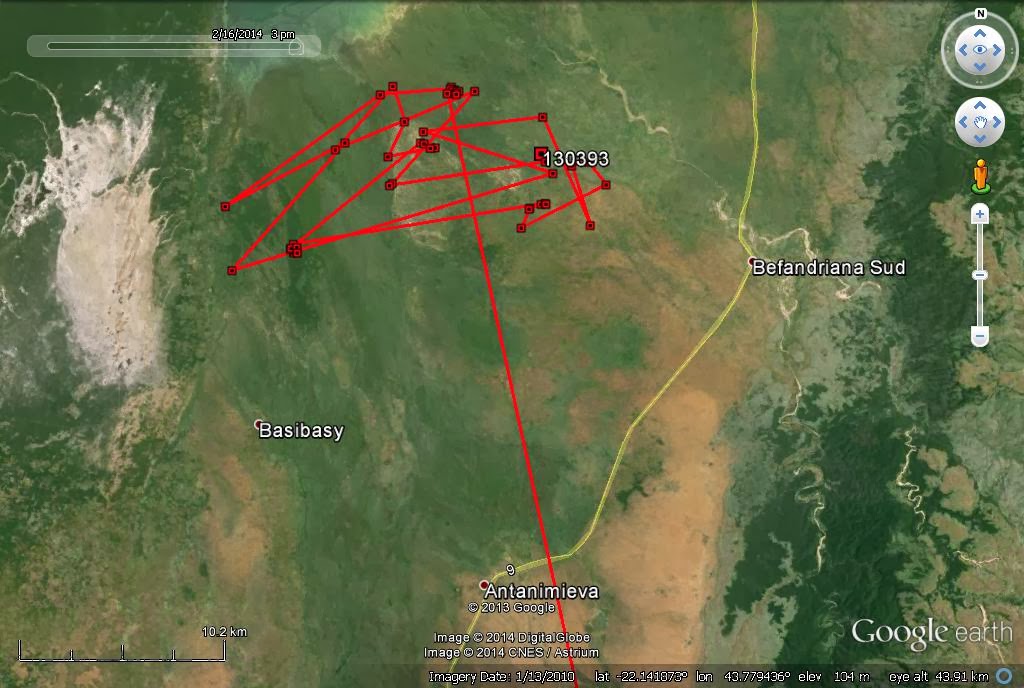
Since the last post, 130393 has been moving around in a fairly limited area of about 300 sq km just south of Lake Ihotry in SW Madagascar.  The sooty falcon team is headed that way, but at the moment their path does not intersect with where 130393 has been spending its time.

130393's movements during 6-16 February 2014.